Aggregate Demand
- Shows that amount of Real GDP that the private, public, and foreign sectors collectively desire to purchase at each possible price level
- The relationship between the price level and the level of GDP is inverse
- Aggregate Demand (AD) Graph Demand Curve
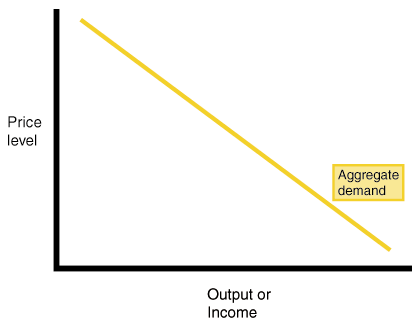
- Three reasons AD is downward sloping
1. Real-Balances Effect
- When the price-level is high households and businesses cannot afford to purchase as much output
- When the price-level is low households and businesses can afford to purchase output
2. Interest-Rate Effect
- A higher price-level increases the interest rate which tends to discourage investment
- A lower price-level decreases the interest rate which tends to encourage investment
3. Foreign Purchases Effect
- A higher price-level increases the demand for relatively cheaper imports
- A lower price-level increases the foreign demand for relatively cheaper United States imports
- Shifts in AD
-There are two parts to a shift in AD:
- A change in C, Ig, G, and/or Xn
- A multiplier effect that produces a greater change than the original change in the 4 components
-Increase in AD=AD shifts to the right
-Decrease in AD=AD shifts to the left
- Consumption
-Household spending is affected by:
1. Consumer wealth
- More wealth=more spending (AD shifts to the right)
- Less wealth=less spending (AD shifts to the left)
2. Consumer expectations
- Positive expectations=more spending (AD shift to the right)
- Negative expectations=less spending (AD shift to the left)
3. Household indebtedness
- Less debt=more spending (AD shifts to the right)
- More debt=less spending (AD shifts to the left)
- Gross Private Investment
-Investment spending is sensitive to:
1. The Real Interest Rate
- Lower=more investment (AD shifts to the right)
- Higher=less investment (AD shifts to the left)
2. Expected Returns
- Higher=more investment (AD shifts to the right)
- Lower=less investment (AD shifts to the left)
3. Expected Returns are influenced by:
- Expectations of future profitability
- Technology
- Degree of excess capacity (existing stock of capital)
- Business taxes
- Government Spending
-More government spending (AD shifts to the right)
-Less government spending (AD shifts to the left)
- Net Exports
-Sensitive to:
- Exchange Rates (international value of dollars)
- Strong money=more imports and fewer exports (AD shifts to the left)
- Weak money=fewer imports and more exports (AD shifts to the right)
- Relative Income
- Strong foreign economies=more exports (AD shifts to the right)
- Weak foreign economies=less exports (AD shifts to the left)
Aggregate Supply
- The level of Real (GDPr) that forms will produce at each Price Level (PL)
Long-Run vs. Short-Run
- Long-Run is a period of time where input prices are completely flexible and adjust to changes in the price-level
- In the long-run, the level of Real GDP supplied is independent of the price-level
- Short-Run is a period of time where input prices are sticky and do not adjust to changes in the price-level
- In the short-run, the level if Real GDP supplied is directly related to the price level
This example shows LRAS and SRAS in the same graph:

Long-Run Aggregate Supply (LRAS)
- The LRAS marks the level of full employment in the economy (analogous to PPC)
Change in the Short-Run
- An increase in SRAS is seen as a shift to right
- A decrease in SRAS is seen as a shift the left
- The key to understanding shifts in SRAS is per unit cost of production
Per-Unit Production Cost=(total input cost)/(total output)
- Determinants of SRAS
- Input prices
- Productivity
- Legal-institutional environment
- Input Prices
-Domestic Resource Prices
- Wages (75% of all business costs)
- Cost of capital
- Raw materials (commodity prices)
-Increase in resources prices=SRAS shifts to the right
-Decrease in resource prices=SRAS shifts to the left
- Productivity
Productivity=(total outputs)/(total inputs)
-More productivity=lower unit production cost (SRAS shifts to the right)
-Lower productivity=higher unit production cost (SRAS shifts to the left)
- Legal Productivity
-Tax and Subsidies
- Taxes ($ to government) on business increase per unit production cost (SRAS shifts to the left)
- Subsidies ($ to government) to business reduce per unit production cost (SRAS shifts to the right)
-Government Regulation
- Government regulation creates creates a cost of compliance (SRAS shifts to the left)
- Deregulation reduces compliance cost (SRAS shifts to the right)
The AS/AD Model
- The equilibrium of AS and AD determines current output (GDPr) and the price level (PL)

- Full Employment: full employment equilibrium exists where AD intersect SRAS and LRAS at the same point
- Recessionary Gap: exists when equilibrium occurs below full employment output
- Inflationary Gap: an inflationary gap exists when equilibrium occurs beyond full employment output
\
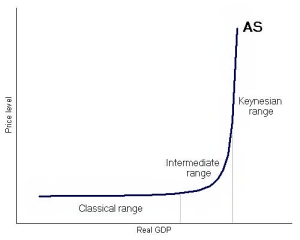
3 Ranges Of The AS Curve
- Horizontal or Keynesian: includes only levels of real output that are less than full employment output, implies that the economy is a recession, therefore you have a decrease in real output
- Vertical or Classical: the economy reaches it's full capacity real output
- Intermediate Range: expansion of real output and price level
Consumption and Saving
- Disposable Income (DI):
-Income after taxes or net income
-Two choices, households can either consume or save
DI=(gross income)-(taxes)
- Consumption:
-Household spending
-The ability to consume is constrained by:
- The amount of disposable income
- The propensity to save
- Autonomous consumption
- Dissaving
APC=C/DI=% DI that is spent
- Saving:
-Household not spending
-The ability to save is constrained by:
- The amount of disposable income
- The propensity to consume
APS=S/DI=% DI that is not spent
- APC & APS
-APC: average propensity to consume
-APS: average propensity to spend
APC+APS=1
1-APC=APS
1-APS=APC
APC>1: Dissaving
(-APS):Dissaving
- MPC & MPS
-Marginal Propensity to Consume
-Percent of every extra dollar earned that is spent
MPC=(Change in Consumption)/(Change in Disposable Income)
-Marginal Propensity to Save
-Percent of every extra dollar earned that is saved
MPC=(Change in Savings)/(Change in Disposable Income)
MPC+MPS=1
1-MPC=MPS
1-MPS=MPC
If you need more help, refer to this!
- Determinants on Consumption and Savings: wealth, expectations, household debt, taxes
- The Spending Multiplier: an initial change in spending causes a larger change in aggregate spending or AD
Multiplier=(Change in AD)/(Change in Spending)
Multiplier=(Change in AD)/(Change in C, G, I, or X)
-Expenditures and income flow continuously which sets off a spending increase in the economy
- Calculating The Spending Multiplier

-Multipliers are (+) when there is an increase in spending and (-) when there is a decrease
- Calculating The Tax Multiplier

-When the government taxes, the multiplier works inverse
-Money is leaving the circular flow
-If there is a tax cut, then the multiplier is positive, because there is now more money in the circular flow
Interest Rate and Investment Demand
- Investment: money spent or expenditures on
- New plants (factories)
- Capital equipment (machinery)
- Technology (hardware and software)
- New homes
- Inventories (goods sold by producers)
- Expected Rates of Return
-How to make decisions: cost/benefit analysis
-How to determine benefits: expected rate of return
-How businesses count the cost: interest costs
-How businesses determine the amount of investment they undertake: compare expected rate of return to interest cost
- If expected return > interest cost, then invest
- If expected return < interest cost, do not invest
- Real (r%) v. Nominal (i%)
-Nominal is the observable rate of interest, real subtracts out inflation an is only know as expost facto
-The real interest rate determines the cost of an investment decision
- Investment Demand Curve (ID)
-Downward sloping
-When interest rates are high, fewer investments are profitable; when interest rates are low, more investments are profitable
-Shifts in ID:
- Cost of production
- Business taxes
- Technological change
- Stock of capital
- Expectations
Fiscal Policy
- Changes in the expenditures or tax revenues of the federal government
- Two tools for fiscal policy:
- Taxes: government can increase or decrease
- Spending: government can increase or decrease spending
- Fiscal policy is enacted to promotes our nation's economic goals: full employment, price stability, economic growth
- Deficit, Surpluses, and Debt
Balance Budget: revenues-expenditures
Budget Deficit: revenues<expenditures
Budget Surplus: revenues>expenditures
Government Debt: sum of all deficits-sum of all surpluses
- Government must borrow money when it ruins a budget deficit
- Government borrows from:
- Individuals
- Corporations
- Financial institutions
- Foreign entities or foreign government
- Two Options (Fiscal Policy)
1. Discretionary (action)
- Expansionary: think deficit
- Contractionary: think surplus
2. Non-Discretionary (non-action)
- Discretionary v. Automatic
-Discretionary: decreasing or increasing tax or spending
-Automatic: unemployment compensation
- Contractionary v. Expansionary
-Contractionary: policy designed to decrease AD, strategy for controlling inflation
-Expansionary: policy designed to increase AD, strategy for increasing GDP combating a recession and reducing unemployment
- Expansionary Fiscal Policy: recession is countered with expansionary policy
-Increase government spending
-Decrease taxes
-Price level increases: this mean expansionary fiscal policy creates some inflation
- Contractionary Fiscal Policy: inflation is countered with contractionary policy
-Decrease government spending
-Increase taxes
-U% increased: this means contractionary
- Automatic or Built in Stabilizer: anything that increases the government budget deficit during a recession and increases it's budget surpluses during inflation without requiring action from policy makers (social security)
- Three Taxes Systems
- Progressive Tax System: average tax rate that rises with GDP
- Proportional Tax System: average tax rate remains constant as GDP changes
- Regressive Tax System: average tax rate falls with GDP

Liked how you thoroughly set up and explained your notes. They are well versed and the graphs greatly help with understanding the concept. A small note is that when reading through, when moving to a different subject, more spaces could be added in between to better show the movement to a new idea. Just a small concern, other than that though, it is very well done.
ReplyDeleteYour notes are very in depth and easy to understand. The inclusion of graphs gave a better understanding of the graph determinants and shifts
ReplyDeleteThe information for this chapter was very well organized with pictures for most parts of the notes. Also the video was a good aspect as it showed another way of presenting the notes. All in all this is very helpful for notes.
ReplyDelete