Thursday, May 15, 2014

Unit 7


Chapter 29- Specialization and Trade
Specialization

  • Occurs when productive agents use resources to focus on producing one or a few products at which they are suited best
International Trade

  • Occurs when buyers and sellers in two nations exchange with one another
  • Closed economy when it neither imports nor exports products
  • Open economy when both imports and exports products
Cost Ratio

  • Provides a method of comparing opportunity costs in producing certain items
Output Problem Approach

  • Based on the most of an item each producer could make if it specializes using a set amount of resources 
Input Problem Approach 

  • Based on the least resources each producer needs to make a set amount of an item 
Rules of Specialization

  • Producers should specialize in making a product only when their cost ratio of doing so is less than that of their trading partners
  • No advantage rule states that nations should not specialize or trade if neither trading partner possesses a cost advantage in producing either products
  • Absolute advantage rule states that two countries should specialize and trade when each partner has an output advantage over the other
  • Comparative advantage rule states that two countries should specialize and trade, even if one produces more output of both products, as long as each partner has a cost advantage over the other
Trade Possibilities Curve

  • Shows the amount of two items a country can obtain by specializing in one and trading for the other
The Balance of Payments

o   A nation’s balance of payments is the sum of all the transactions that take place between its residents and the residents of all foreign nations.
§  Exports and Imports of Goods, Exports and Imports of Services, tourist expenditures, interest and dividends received or paid abroad, and purchases and sales of financial or real assets abroad
o   The US Commerce Department’s Bureau of Economic Analysis complies the balance-of-payments statement each year.
§  Shows all the payments a nation receives from foreign countries and all the payments it makes to them.
o   Three Components
§  The Current Account
·         The current account summarizes U.S. trade in currently produced goods and services
·         US Exports have a plus (+) sign – they credit and create revenue
·         US Imports have a minus (-) sign – they are debit and reduce the stock of foreign currencies in the United States
·         Balance on Goods
o   A country’s balance of trade on goods is the difference between its exports and its imports of goods
·         Balance on Services
o   Services include insurance, consulting, travel, and brokerage services
·         Balance on Goods & Services
o   The difference between U.S. exports of goods and services and U.S. imports of goods and services
§  Trade deficit – imports > exports
§  Trade surplus – exports > imports
·         Balance on Current Account
o   Represents the net investment income, represents the difference between
§  1. The interest and dividend payments foreigners paid the United States for the use of exported U.S. capital
§  2. The interest and dividends the United States paid for the use of foreign capital invested in the United States
o   Includes Net transfers and Net investment Income
§  Net Transfers include foreign aid, pensions paid to U.S. citizens living abroad, and remittances by immigrants to relatives abroad
·         “The exporting of goodwill and the importing of ‘thank-you notes’.”
o   By adding all transactions in the current account, obtain the balance on current account
§  The Capital Account
·         The capital account summarizes the purchase or sale of real or financial assets and the corresponding flows of monetary payments that accompany them.
o   Items (an office building or bonds) bought from the U.S. count as exports (+) as they represent in--payments of foreign currencies
§  Key Point – foreign purchases of assets in the U.S.
o   Items located in foreign countries and sold to companies in that country count as imports (-) as they represent out-payments of domestic currencies
§  Key Point- U.S. purchases of assets abroad
·         Exports and Imports balance on the balance on capital account
§  The Official Reserves Account
·         The central banks of nations hold quantities of foreign currencies called official reserves.
·         Functions just the same as reserves in any other bank
·         Basically used to make up any final balancing amount
o   Putting it all Together
§  The three components of the balance of payments (the current account, the capital account, and the official reserves account) must together equal zero.
§  Every unit of foreign exchange used (as reflected in a minus out-payment or debit transaction) must have source (a plus in-payment or credit transaction)
o   Payments Deficits and Surpluses
§  Balance-of-payments deficits and surpluses, though the balance of payments must always sum to zero, this refers to imbalances between the current and capital accounts
·         The US favors balance-of-payments deficits – a drawing down of official reserves

·         A balance-of-payments surplus is a building up of official reserves
A BOB "Chart"

Assets/Creditr (Inflow)
Debits/Liabilities (Outflow)
Current Account


-Balance on goods and services
-Net exports
-Balance of trade
-Exports
-Tourism here
-Imports
-Tourism there
Net Investments
-Interest/dividend payments
-Foreign ppay to U.S. for use of exported capital
-Interest/dividend payments
-The U.S. made for the use foreign capital invested in U.S.
Net Transfers
-Aid to U.S.
-Include royalties
-Aid to their country
-Their royalties
Financial Account
-Capital inflows
-Direct investment by foreigners
-Purchases of stocks and bonds by foreigners
-Capital ooutflows
-Direct investment by U.S. over there
-Purchases of stocks and bonds by U.S.
Official Reserves
-Currencies
-Gold
-IMF
-Currencies
-Gold
-IMF

Comparative and Absolute Advantage

  • The division of labor into specific task and roles intended to increase the productivity of workers is called known specialization
  • Globalization is the process of increasing the productivity and interdependence of the world's markets and businesses
  • Absolute advantage refers to a country's ability to produce a certain more of a good or service than another country
  • The absolute advantage rule states that two countries should specialize and trade when each other partner has an output advantage over the other
  • Comparative advantage refers to a country's ability to produce a particular good with a lower opportunity cost than another country
  • Gains from trade or based on comparative advantage, not absolute advantage
  • Comparative advantage is the basis for all trade between individuals, regions, and nations
The Foreign Exchange Market

  • A foreign exchange market is a market in which currencies are exchanged for one another
  • The equilibrium prices in these markets are called exchange rates
  • The rate at which the currency of one nation can be exchanged for the currency of another nation
  • Depreciation and Appreciation: an increase in the U.S. demand for Japanese goods will increase the demand for yen and raise the dollar price of yen

Supply of the Dollar
Demand of the Dollar
-Comes from U.S. citizens, banks, and industries wanting to purchase foreign goods, investments assets and to make payments to transfer foreigners
-Comes from foreigners, banks, and industries wanting to purchase our goods, investments, assets, and to make transferred payments to U.S.


  • 5 Determinants of Supply and Demand in Foreign Exchange Market
  1. Change in buyers taste
  2. Change in relative incomes
  3. Change in relative prices
  4. Change in interest rates
  5. Change in expectations
Exchange Currencies

  • Sell exports and buy imports
  • Invest in a countries stocks and bonds
  • Build stores and factories in other markets
  • Hold currencies in bank accounts for future exports, imports, and business loans 
  • To speculate on currency values
Flexible and Fixed Exchange Rate
Here is a video on fixed exchange rates!

  • Flexible: determined by market forces with little or no government intervention
  • Fixed: determined and periodically adjusted by government


Thursday, April 10, 2014

Unit V

SRAS
  • Time too short for wages to adjust to price level
  • Workers may not be aware of changes in their real wages due to inflation, therefore they have adjusted their labor supply decisions and wage demands accordingly
  • Nominal wages: the amount our money received per hour, per day, or year


Price Level
Wage Level
Employment Level
Implications
Keynsian or Horizontal
Fixed
Fixed
Flexible
Output depends on change in supply
Intermediate
Flexible
Fixed
Flexible
Output depends on change in price level and employment level
Vertical or Classical
Flexible
Fixed
Fixed
Output depends on change in price level

LRAS
  • Time long enough for wages to adjust to price level
  • Key Assumptions
  1. Wages and prices are flexible
  2. Changes in wages and price off set one another
  3. Represented by a vertical line
  • Demand Pull Inflation

  • Economic Growth

  • Cost Push Inflation

  • Recession

Phillip's Curve

  • There is an inverse relationship between inflation and unemployment
  • If inflation persist and the expected rate of inflation rises, then the entire SRPC moves upward (stagflation is possible)
  • If the inflation expectations drop such as
  • technology then the SRPC will move downward
  • Decrease in AD= down/right along SRPC
  • SRAS shifts to the right=SRPC shifts to the left (disinflation)
  • SRAS shifts to the left=SRPC shifts to the right (stagflation)
LRPC

  • Only affected by unemployment  (seasonal, frictional, structural)
  • The major LRPC assumption is that more worker benefits create higher natural rates, and fewer worker benefits create fewer natural rates of unemployment
  • Unemployment rises, LRPC shifts right
  • Unemployment lowers, LRPC shifts left
  • Misery Index: combination of inflation and unemployment in a given year, single digit misery is good
Supply Shock

  • It is a rapid and significant increase in resource prices, which causes SRAS to shift while producing a corresponding sifts in the SPRC
  • Examples:
  1. Increase wages
  2. Oil embargo
  3. Depreciation of the U.S. dollar
Stagflation

  • Where there is a simultaneous increase in inflation and unemployment
Disinflation

  • When inflation decreases
Supply-side Economics (Reaganomics) 

  • Tend to believe that the AS curve will determine levels of inflation, unemployment,and economic growth
  • Also supports policies that promote GDP growth by arguing that high marginal tax rates alone current system if transfer payments unemployment, social security, welfare)
  • They provide disincentives to work, invest, innovate, and undertake entrepreneur ventures
Marginal Tax Rate

  • Amount of tax paid on an additional dollar of income, changes from year to year
Laffer Curve 

  • As tax rates increase from 0, tax revenues increase from 0 to maximum level then decline
  • Tax revenue=government revenue
  • Tax rates above or ideal rate will decrease tax revenue
Three Criticisms

  1. Where the economy is located on the Laffer Curve is difficult to determine
  2. Tax cuts increase demand which confule inflation, therefore demand may exceed supply
  3. The impact of tax rates on incentives to work, save, invest are small
Here is a video on the Phillip's Curve if you have any more questions!

Sunday, March 30, 2014

Unit IV (Chapter 13&14)


Chapter 13

Uses of Money 

  1. Medium Exchange: using to barter our trade
  2. Unit of Account: gives money economic worth
  3. Store of Value: dollar does not fluctuate
Types of Money

  1. Representative Money: paper money that is backed by a tangible product
  2. Commodity Money: gold a silver coins, gets value from material that is is made of 
  3. Flat Money: money because government said so 
Characteristics of money 

  1. Durability: 
  2. Portability: carry money everywhere
  3. Divisibility: money can be broken down
  4. Uniformity: money is identical
  5. Scarcity:
  6. Acceptability: 
M1 Money (more liquid) 

  • Consist of currency circulation (paper and coins)
  • Travelers checks
  • Checkable deposits
  • Demand deposits
M2 Money 

  • Savings accounts
  • Money market accounts
  • Accounts held by banks outside of the United States
  • Adding M1 money
Chapter 14

  • Assets=(Liabilities)+(Net Worth) 
  • Reserve Ration=(Commercial Bank's Required Reserves)/(Commercial Bank's Checkable Deposit Liabilities)
Three Important Issues

  1. Excess Reserves=(Actual Reserves)-(Required Reserves)
  2. Control of lending liability
  3. Asset or liability to which bank?
  • Banks create money by lending excess reserves and destroy it by loan payment , purchasing bonds from the public also creates money
  • Money Multiplier=(1)/(Required Reserve Ratio)
  • Maximum Checkable Deposit Creation=(Excess Reserves)(Monetary Multiplier)
Mr. Mac AP Macroeconomics-Multiple Deposit Expansion
Reserve Equipment 

  • The Fed requires banks to always have some money readily available to meet consumers' demand for cash
  • The amount, set by the Fed, is the required reserve ratio
  • The required reserve ratio is the percentage of demand deposits (checking account balance) that must not be loaned out
  • Typically the required reserve ration equals 10%
The Money Multiplier

  • Similar to the spending multiplier, the money multiplier shows us the impact of a change in demand deposits on loans and eventually the money supply
  • To calculate the multiplier, divide 1 by the required reverse ratio
  • Money Multiplier=(1)/(Reserve Ratio)
The Three Types of Multiplier of Multiple Deposit Expansion
Type 1
  • Calculate the initial change in excess reserves
  • The smount of a single bank can loan from the initial deposit
Type 2

  • Calculate the change in loans in the banking system
Type 3

  • Calculate the change in the money supply
  • Sometimes type 2 and 3 will have the same result (no Fed involvement)
Monetary Policy (Federal Reserve Bank)

  • Influencing the economy through changes in reserves which influences the money supply and available credit
4 Options of Monetary Policy

  1. Reserve Requirement: percent that is set by the FED of the minimum reserve a bank must keep
  2. Discount Rate: the rate of interest that the FED charges for overnight loans to banks
  3. Federal Fund Rate: rate that FDIC members charge each other for loans 
  4. OMO (Open Market Operation): either buy or sell securities (bonds)
  • If the FED buys bonds they expand (expansionary) money supply
  • If they sell bonds they decrease money supply (contractionary)
Prime Rate
  • Interest rate that banks charge their most credit worthy borrowers


Expansionary
Contractionary
OMO
Buy Bonds
Sell Bonds
Discount Rate
Federal Fund Rate
Required Reserve Ratio


  • If initial deposit is not new money, the total change in money supply is only the new money created by the banking system
  • Single Bank: amount of money single banks can create (loan out)=ER
AR-RR+ER

  • Banking Sytem: can create money by a multiple of its initial ER

Deposit Multiplier= (1)/(RR)

System New Money= (Deposit Multiplier)(Initial ER)


To understand the unit better, watch this!


Graphs that might help understand Monetary Policy more!


Sunday, March 23, 2014

Money & Banking/ Monetary Supply Video Notes

Unit 4- Part 1
There are three types of money; commodity, representative, and FIAT. Commodity represents good that can also be represented as money. Representative money which is money backed up by gold, and FIAT being the opposite of that. There are also three functions of money; medium of exchange, store of value, and unit of account. Medium of exchange is a substances through which things pass. Store value meaning that you still want money that you could be possibly saving to keep its value, you want it to be worth just as much later. Unit of account deals how price equals worth/value.
This was the information that I was able to learn when watching the video. It was extremely helpful when getting the basic understanding of the types of money and what each one of them actually means. The video was also not complicated to understand too.

Unit 4- Part 3

The price that you pay to get money is the interest rate, meaning that the interest rate would be on your vertical axis. Along your vertical axis you put quantity money on your horizontal axis. The demand of money always slopes down because when the price is high, quantity demanded is low. When the interest rate is low people want to borrow money more. Transaction demand and asset demand are the component of the demand of money. Supply of money is vertical because it does not vary on the interest rate. When increasing demand (shifting left), pressure is put on interest rate causing it to rise; the quantity stays the same because supply of money is vertical. In order to stabilize interest rates, the supply of money must shift to the right.
This video was extremely simple and something that I have already sort of seen before. It went over basic understandings of which there is a slope with the demand of money and the vertical line of supply of money. I found the video extremely helpful.

Unit 4- Part 4

There are three tools of monetary policy that the Fed has; two of these are expansionary and contractionary. If the Fed wants to expand money supply they decrease the required reserves and if they want to contract they would increase the required reserves. If they decrease the required reserves there will be more excess reserves to use on loans. If the Fed wants banks to borrow more money they would lower the discount rate, and if they want to discourage banks they raise the discount rate. To increase money supply the Fed would buy bonds, and to contract the money supply they would sell bonds. The Federal Open Market Committee makes the decisions. The Federal Funds Rate is the rate at which banks borrow money from each; it has nothing to do with the Fed.
This video went expansionary and contractionary dealing with monetary policy. It was something I had already learned before in the previous unit, but the video gave me a more clearer understanding of it and its use in this unit.

Unit 4- Part 7

I found it really hard to retain information from this video. The lady did not explain everything clearly and the work she did on the smart board became confusing after a period of time. I did not find the video as helpful as the previous ones.

Unit 4- Part 8

The video was a review of the work we had been doing in class, it was simple to understand as well.The video was a review of how to find the multiplier and how you apply the required reserve to the problem, specifically to the loans.

Unit 4-Part 9

I found this video hard to understand. The explanations did not really make sense to me. The information videos seem to be the ones that do not have to do with the money demand graphs. I did not find the video very helpful.


Monday, March 3, 2014

Unit III

Aggregate Demand

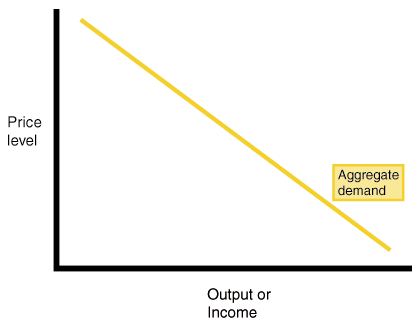
  • Shows that amount of Real GDP that the private, public, and foreign sectors collectively desire to purchase at each possible price level
  • The relationship between the price level and the level of GDP is inverse
  • Aggregate Demand (AD) Graph Demand Curve

  • Three reasons AD is downward sloping
1. Real-Balances Effect

  • When the price-level is high households and businesses cannot afford to purchase as much output
  • When the price-level is low households and businesses can afford to purchase output

2. Interest-Rate Effect

  • A higher price-level increases the interest rate which tends to discourage investment
  • A lower price-level decreases the interest rate which tends to encourage investment

3. Foreign Purchases Effect

  • A higher price-level increases the demand for relatively cheaper imports
  • A lower price-level increases the foreign demand for relatively cheaper United States imports
  • Shifts in AD
-There are two parts to a shift in AD:
  1. A change in C, Ig, G, and/or Xn
  2. A multiplier effect that produces a greater change than the original change in the 4 components
-Increase in AD=AD shifts to the right
-Decrease in AD=AD shifts to the left

  • Consumption
-Household spending is affected by:
1. Consumer wealth
  • More wealth=more spending (AD shifts to the right)
  • Less wealth=less spending (AD shifts to the left)
2. Consumer expectations
  • Positive expectations=more spending (AD shift to the right)
  • Negative expectations=less spending (AD shift to the left)
3. Household indebtedness
  • Less debt=more spending (AD shifts to the right)
  • More debt=less spending (AD shifts to the left)
  • Gross Private Investment
-Investment spending is sensitive to:

1. The Real Interest Rate
  • Lower=more investment (AD shifts to the right)
  • Higher=less investment (AD shifts to the left)
2. Expected Returns
  • Higher=more investment (AD shifts to the right)
  • Lower=less investment (AD shifts to the left)
3. Expected Returns are influenced by:
  • Expectations of future profitability
  • Technology
  • Degree of excess capacity (existing stock of capital)
  • Business taxes
  • Government Spending
-More government spending (AD shifts to the right)
-Less government spending (AD shifts to the left)
  • Net Exports
-Sensitive to:
  • Exchange Rates (international value of dollars)
  1. Strong money=more imports and fewer exports (AD shifts to the left)
  2. Weak money=fewer imports and more exports (AD shifts to the right)
  • Relative Income
  1. Strong foreign economies=more exports (AD shifts to the right)
  2. Weak foreign economies=less exports (AD shifts to the left)


Aggregate Supply 

  • The level of Real (GDPr) that forms will produce at each Price Level (PL)
Long-Run vs. Short-Run 

  • Long-Run is a period of time where input prices are completely flexible and adjust to changes in the price-level
  • In the long-run, the level of Real GDP supplied is independent of the price-level
  • Short-Run is a period of time where input prices are sticky and do not adjust to changes in the price-level
  • In the short-run, the level if Real GDP supplied is directly related to the price level
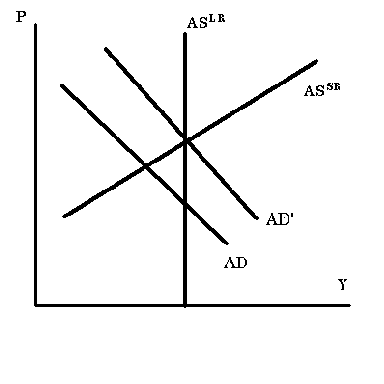
This example shows LRAS and SRAS in the same graph:

Long-Run Aggregate Supply (LRAS)

  • The LRAS marks the level of full employment in the economy (analogous to PPC)
Change in the Short-Run

  • An increase in SRAS is seen as a shift to right
  • A decrease in SRAS is seen as a shift the left
  • The key to understanding shifts in SRAS is per unit cost of production 
Per-Unit Production Cost=(total input cost)/(total output)

  • Determinants of SRAS
  1. Input prices
  2. Productivity
  3. Legal-institutional environment
  • Input Prices
-Domestic Resource Prices

  • Wages (75% of all business costs)
  • Cost of capital 
  • Raw materials (commodity prices)
-Increase in resources prices=SRAS shifts to the right
-Decrease in resource prices=SRAS shifts to the left

  • Productivity
Productivity=(total outputs)/(total inputs)

-More productivity=lower unit production cost (SRAS shifts to the right)
-Lower productivity=higher unit production cost (SRAS shifts to the left)
  • Legal Productivity
-Tax and Subsidies
  • Taxes ($ to government) on business increase per unit production cost (SRAS shifts to the left)
  • Subsidies ($ to government) to business reduce per unit production cost (SRAS shifts to the right)
-Government Regulation
  • Government regulation creates creates a cost of compliance (SRAS shifts to the left)
  • Deregulation reduces compliance cost (SRAS shifts to the right)
The AS/AD Model
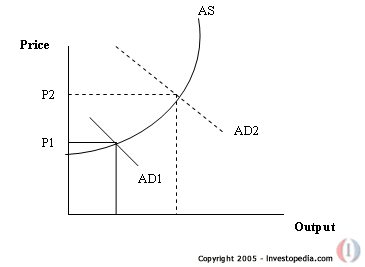
  • The equilibrium of AS and AD determines current output (GDPr) and the price level (PL)
  • Full Employment: full employment equilibrium exists where AD intersect SRAS and LRAS at the same point
  • Recessionary Gap: exists when equilibrium occurs below full employment output
  • Inflationary Gap: an inflationary gap exists when equilibrium occurs beyond full employment output
\
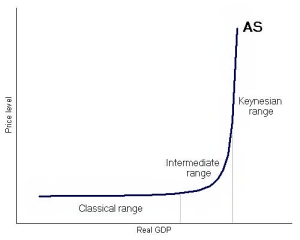
3 Ranges Of The AS Curve

  • Horizontal or Keynesian: includes only levels of real output that are less than full employment output, implies that the economy is a recession, therefore you have a decrease in real output
  • Vertical or Classical: the economy reaches it's full capacity real output
  • Intermediate Range: expansion of real output and price level


Consumption and Saving

  • Disposable Income (DI):
-Income after taxes or net income
-Two choices, households can either consume or save
DI=(gross income)-(taxes)

  • Consumption:
-Household spending
-The ability to consume is constrained by:

  • The amount of disposable income
  • The propensity to save
  • Autonomous consumption
  • Dissaving
APC=C/DI=% DI that is spent

  • Saving
-Household not spending
-The ability to save is constrained by:

  • The amount of disposable income
  • The propensity to consume
APS=S/DI=% DI that is not spent

  • APC & APS
-APC: average propensity to consume
-APS: average propensity to spend

APC+APS=1
1-APC=APS
1-APS=APC
APC>1: Dissaving 
(-APS):Dissaving

  • MPC & MPS
-Marginal Propensity to Consume
-Percent of every extra dollar earned that is spent
MPC=(Change in Consumption)/(Change in Disposable Income) 


-Marginal Propensity to Save

-Percent of every extra dollar earned that is saved
MPC=(Change in Savings)/(Change in Disposable Income)


MPC+MPS=1

1-MPC=MPS
1-MPS=MPC

If you need more help, refer to this!


  • Determinants on Consumption and Savings: wealth, expectations, household debt, taxes
  • The Spending Multiplier: an initial change in spending causes a larger change in aggregate spending or AD
Multiplier=(Change in AD)/(Change in Spending)
Multiplier=(Change in AD)/(Change in C, G, I, or X)
-Expenditures and income flow continuously which sets off a spending increase in the economy

  • Calculating The Spending Multiplier

-Multipliers are (+) when there is an increase in spending and (-) when there is a decrease

  • Calculating The Tax Multiplier

-When the government taxes, the multiplier works inverse
-Money is leaving the circular flow
-If there is a tax cut, then the multiplier is positive, because there is now more money in the circular flow


Interest Rate and Investment Demand 

  • Investment: money spent or expenditures on
  1. New plants (factories)
  2. Capital equipment (machinery)
  3. Technology (hardware and software)
  4. New homes
  5. Inventories (goods sold by producers)
  • Expected Rates of Return
-How to make decisions: cost/benefit analysis
-How to determine benefits: expected rate of return
-How businesses count the cost: interest costs
-How businesses determine the amount of investment they undertake: compare expected rate of return to interest cost
  • If expected return > interest cost, then invest
  • If expected return < interest cost, do not invest
  • Real (r%) v. Nominal (i%)

-Nominal is the observable rate of interest, real subtracts out inflation an is only know as expost facto
-The real interest rate determines the cost of an investment decision
  • Investment Demand Curve (ID)

-Downward sloping
-When interest rates are high, fewer investments are profitable; when interest rates are low, more investments are profitable
-Shifts in ID:
  1. Cost of production
  2. Business taxes
  3. Technological change
  4. Stock of capital 
  5. Expectations

Fiscal Policy
  • Changes in the expenditures or tax revenues of the federal government
  • Two tools for fiscal policy:
  1. Taxes: government can increase or decrease
  2. Spending: government can increase or decrease spending
  • Fiscal policy is enacted to promotes our nation's economic goals: full employment, price stability, economic growth
  • Deficit, Surpluses, and Debt
Balance Budget: revenues-expenditures
Budget Deficit: revenues<expenditures
Budget Surplus: revenues>expenditures
Government Debt: sum of all deficits-sum of all surpluses
  • Government must borrow money when it ruins a budget deficit
  • Government borrows from:
  1. Individuals
  2. Corporations
  3. Financial institutions
  4. Foreign entities or foreign government
  • Two Options (Fiscal Policy)

1. Discretionary (action)
  • Expansionary: think deficit
  • Contractionary: think surplus

2. Non-Discretionary (non-action)
  • Discretionary v. Automatic

-Discretionary: decreasing or increasing tax or spending
-Automatic: unemployment compensation
  • Contractionary v. Expansionary

-Contractionary: policy designed to decrease AD, strategy for controlling inflation
-Expansionary: policy designed to increase AD, strategy for increasing GDP combating a recession and reducing unemployment
  • Expansionary Fiscal Policy: recession is countered with expansionary policy

-Increase government spending
-Decrease taxes
-Price level increases: this mean expansionary fiscal policy creates some inflation
  • Contractionary Fiscal Policy: inflation is countered with contractionary policy

-Decrease government spending 
-Increase taxes 
-U% increased: this means contractionary 
  • Automatic or Built in Stabilizer: anything that increases the government budget deficit during a recession and increases it's budget surpluses during inflation without requiring action from policy makers (social security)
  • Three Taxes Systems
  1. Progressive Tax System: average tax rate that rises with GDP
  2. Proportional Tax System: average tax rate remains constant as GDP changes
  3. Regressive Tax System: average tax rate falls with GDP